By Our Correspondent
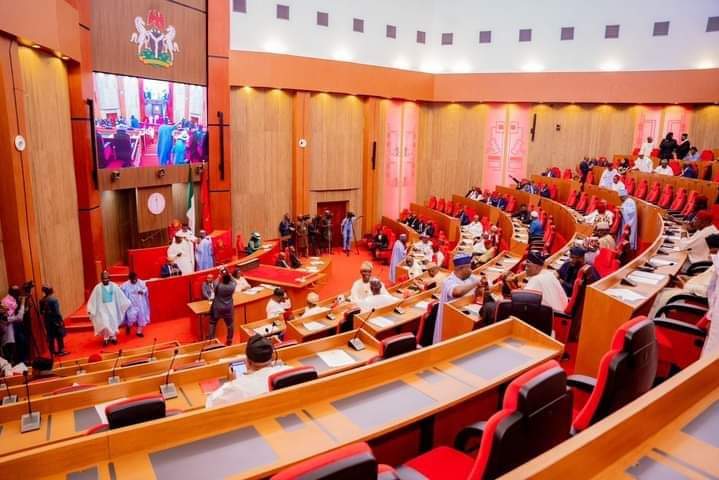
The Senate on Wednesday passed the Electoral Act (Amendment) Bill, 2026, after a marathon session that lasted several hours, firmly dismissing claims that it rejected the electronic transmission of election results.
Following the passage of the bill, Senate President, Godswill Akpabio, denied reports circulating on social media suggesting that lawmakers voted against electronic transmission of results, describing such claims as misleading.
Some of the highlights of the amendments are the increase in the penalty for electoral offences like vote buying from N500,000 to N5 million and option of two years in prison, reduction of the period of notice of election from 360 days to 180 days before the election.
Others are the reduction of the period of submission of list of candidates to INEC from 280 days to 90 days, use biometric voter accreditation (BIVAS) as the only means of identification.
However, controversy ensued during consideration of the amendment to Clause 60, Subsection 3, of the bill, which deals with mandatory electronic transmission of election results.
The Senate did not explicitly approve the committee’s recommendation for electronic transmission of election results from polling units to INEC Result Viewing (IREV) real time, but retained what is in the principal Act to transfer results from polling units.
This led to social media reports that the upper chamber rejected a proposal that would have compelled presiding officers of the Independent National Electoral Commission (INEC) to transmit results electronically from polling units to the INEC Result Viewing (IREV) portal in real time, immediately after signing and stamping the prescribed result forms.
However, Akpabio insisted that the interpretation was incorrect, stressing that the Senate did not remove electronic transmission of results from the law.
Addressing senators, he said: “Distinguished colleagues, the social media is already awash with reports that the Senate has literally rejected electronic transmission of results. That is not true. What we did was to retain the electronic transmission which has been in the Act and was used in 2023.
“So please, do not allow people to confuse you. If you are in doubt, we will make our final votes and proceedings available to you if you apply.
“This Senate, under my watch, has not rejected electronic transmission of results. It is in my interest as a participant in the next election for such to be done. So please, don’t go with the crowd.
“We have retained what was in the previous provision by way of amendment. That provision already allows electronic transmission, and it remains part of our law. We cannot afford to go backwards.”
In the same vein, Senate spokesperson, Senator Yemi Adaramodu, told journalists that the Senate did not reject the committee’s recommendation that election results be transmitted electronically to INEC’s IREV portal in real time, explaining that the wording was adjusted to avoid technical complications.
Adaramodu also noted that the amendment removed the power to declare a runner-up as winner in cases where a candidate initially declared winner by INEC is later found to be unqualified to have run in the election.
The issue of electronic transmission of election results has remained one of the most sensitive aspects of Nigeria’s electoral reforms since the 2023 general elections, with civil society organisations and opposition parties consistently advocating clearer legal provisions to strengthen transparency and public confidence in the electoral process.
Akpabio’s clarification was aimed at calming public concerns and correcting what he described as deliberate or careless misrepresentation of the Senate’s action on the bill, as the National Assembly continues work on electoral reforms ahead of future elections.
Following the passage of the bill, the Senate announced members of the Conference Committee to harmonise its version with that of the House of Representatives. The committee is chaired by Simon Lalong (Plateau South). The members include Senators Adeniyi Adegbonmire (Ondo Central), Mohammed Tahir Monguno (Borno North), Adamu Aliero (Kebbi Central), Orji Uzor Kalu (Abia North), Abba Moro (Benue South), Asuquo Ekpeyong (Cross River South), Aminu Abbas (Adamawa Central) and Tokunbo Abiru (Lagos East) as members.
Meanwhile, the Senate has adjourned plenary until February 24, 2026, to allow committees to focus on the 2026 budget defence by ministries, departments and agencies (MDAs).